If you have been seeing colourful “fluid bears” all over social media and Singapore activity platforms, you are not alone. Acrylic pour bear workshops have moved from niche craft activity to a popular weekend plan, date idea, birthday outing, and team bonding format. In Singapore, that rise fits a bigger pattern. The National Arts Council’s 2023 arts data shows that nearly 6 in 10 Singaporeans attended arts events in person, while close to 7 in 10 engaged with arts online. In late 2025, CNA also reported that creative workshops were gaining traction as experience-based gifts, with some platforms saying sales were up by as much as 20 percent year on year.
For beginners, the appeal is obvious. You do not need to sketch, paint realistic subjects, or know colour theory to leave with something striking. The process is tactile, forgiving, and visually dramatic. That makes acrylic pour bear workshops especially attractive to people who want a creative experience without the pressure that often comes with traditional art classes.
What exactly is an acrylic pour bear workshop?
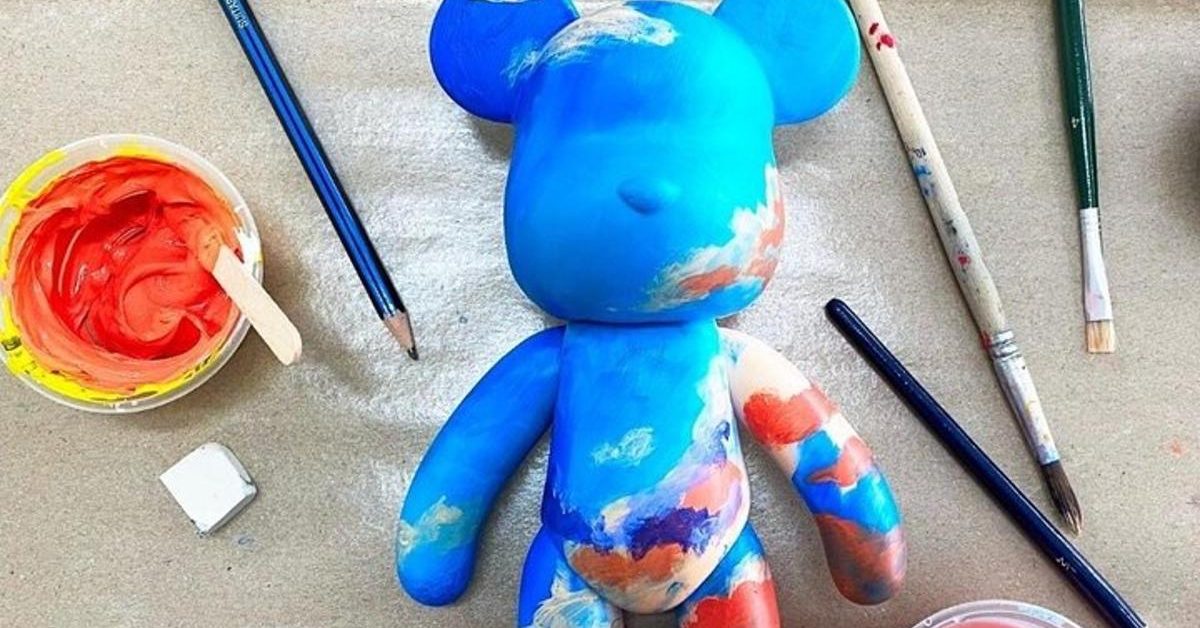
An acrylic pour bear workshop is a hands-on art session where participants decorate a blank bear figurine using fluid acrylic paint. Instead of painting with brushes, you pour, layer, drip, or tilt paint across the surface so the colours move organically and create abstract marbling effects. Singapore workshops often market the activity under related names such as “acrylic pour bear,” “bear acrylic pouring,” or “fluid bear art workshop,” but the core idea is the same.
The “pour” part comes from acrylic pouring, a fluid art technique that uses acrylic paint mixed to a more flowing consistency, often with a pouring medium that helps the paint level smoothly and reduces cracking. Artist material brands such as Liquitex describe pouring medium as a way to increase flow, maintain adhesion and flexibility, and produce a smooth, glossy finish.
In simple terms, the workshop turns a plain toy-like sculpture into a one-off art object. No two bears come out the same, which is a big part of the fun.
Why are acrylic pour bear workshops so popular in Singapore?
Singapore is a strong market for short, social, bookable experiences. That matters because acrylic pour bear workshops fit neatly into the way many people here plan leisure time. They are compact, photogenic, beginner-friendly, and easy to do with friends, partners, children, or colleagues. Current Singapore listings show workshops being sold for couples, families, private groups, and team bonding sessions.
There is also a cultural shift toward experience-led spending. CNA reported in December 2025 that more shoppers in Singapore were choosing experience-based gifts such as spa treatments, fitness classes, and art workshops over physical products, and some platforms said these sales were up by as much as 20 percent compared with the year before. The same report noted growing interest from corporate buyers as well, not just individual consumers.
That trend lines up with the broader arts environment. Singapore’s public sector outcomes review, based on the 2023 Population Survey on the Arts, found continued strong engagement with arts and culture. For workshop operators, that creates a healthy market. For beginners, it means more choices, more price points, and more niche formats than a few years ago.
What happens during a typical acrylic pour bear workshop?
While every studio runs things a little differently, the basic format is fairly consistent across Singapore.
1. You choose your bear and colours
Most workshops start with a blank figurine, then let you pick a colour palette. Current Singapore listings show examples such as an 18 cm bear with up to three pouring colours, or a 23 cm figurine with multiple paint options. Some studios also let participants choose between a bear and another shape, such as a rabbit.
2. The facilitator explains the pouring method
Beginners are usually shown how to layer colours, how much paint to use, and how to let the paint flow without turning muddy. Some workshops are fully guided, while others are more like creative self-led sessions with materials prepared for you. Studios commonly provide aprons, gloves, cups, mixing sticks, and pre-mixed fluid paints.
3. You pour, tilt, and watch the pattern develop
This is the most satisfying part. Rather than “painting inside the lines,” you let gravity and viscosity help create the final look. The result is unpredictable, but not random. Small decisions, like colour order, paint volume, angle, and timing, all influence the finished piece. That blend of control and surprise is why fluid art feels exciting even for people who say they are “not artistic.”
4. Your bear dries before collection
Acrylic pouring is not a take-it-and-go activity in the same way as candle making or a simple canvas workshop. Singapore providers commonly note that the figurine needs drying time, and some require collection on another day. One current Klook-listed studio says bears can be collected three days after the session, while other local providers note that participants should arrange self-pickup or delivery later because the paint needs time to set.
How long does it take, and what does it cost in Singapore?
For beginners, one of the biggest advantages is that the time commitment is relatively low. Current Singapore listings show acrylic pour bear and related fluid bear sessions running from about 1 hour to 2 hours, with many clustered around the 1.5-hour mark.
Pricing varies based on venue, figurine size, level of guidance, and whether the session is private or join-in. As of March 2026, public listings show examples such as:
That spread matters for beginners because it shows the category is not priced as one fixed luxury activity. There are entry-level options, mid-range studio experiences, and premium listings that position the workshop more as a date, outing, or curated lifestyle activity.
Do you need any art experience?
No, and that is one of the strongest selling points.
Several current Singapore workshop listings explicitly state that no prior art experience is needed. That is not just marketing language. The structure of the activity genuinely lowers the barrier to entry because the goal is not to draw proportion accurately or paint clean details with a brush. Instead, beginners work with motion, colour flow, and surface coverage.
There is also research behind the “beginner-friendly” feeling. A widely cited study published in Art Therapy found that 45 minutes of art making produced a statistically significant reduction in cortisol in 39 healthy adults, and the results did not significantly differ by prior experience with art making. In that study, mean cortisol fell from 17.85 ng/ml before the session to 14.77 ng/ml after it. A more recent 2024 Frontiers in Psychology study also found that a four-week art-making intervention significantly reduced perceived stress among college students.
That does not mean an acrylic pour bear workshop is therapy, and it should not be marketed as a clinical treatment. But it does help explain why so many beginners describe these sessions as calming, immersive, or mentally refreshing.
What makes this workshop different from a normal painting class?
Acrylic pour bear workshops sit somewhere between craft, décor, and experiential entertainment.
In a traditional painting class, the emphasis is often on technique, subject matter, or copying a reference image. In an acrylic pour bear workshop, the emphasis is on process and outcome. You are making an object that doubles as a keepsake, gift, or display piece. That product-oriented result matters in a city like Singapore, where people often look for activities that feel worth the spend, both as an experience and as something tangible to bring home.
There is also a stronger social factor. The workshop is easy to do in parallel with others because each person can choose a different palette and still succeed. That makes it especially adaptable for birthdays, family sessions, and work events.
Who is an acrylic pour bear workshop best for?
This format works well for a surprisingly wide audience because it asks for very little technical skill and offers a very visual payoff.
It is particularly suitable for:
- First-time crafters who want a creative activity without a steep learning curve
- Couples looking for a date that feels more interactive than dinner
- Parents who want a guided art activity for children or tweens
- Friend groups celebrating birthdays or casual meetups
- Companies planning team bonding, client events, or employee engagement sessions
For businesses, the workshop also solves a common problem with corporate activities. It is structured enough to run smoothly, but flexible enough that people do not feel forced into awkward participation. Some Singapore providers explicitly offer private formats, with examples ranging from minimum 5 pax sessions to private workshops accommodating groups of up to 35 guests.
What should beginners know before booking?
Before you reserve a session, a few practical details can make the experience better.
Check the workshop format
Some sessions are guided step by step. Others are closer to art jamming, with materials and basic instructions provided. If you are a true beginner, guided formats usually feel more comfortable.
Ask about the figurine size and materials
A workshop that includes an 18 cm bear and three colours will feel different from one built around a 23 cm figure with more paint volume and more studio support. Those details affect both value and the final look.
Plan for drying and collection
This is the detail many first-timers miss. Fluid art needs time to dry properly, so same-day pickup is not always possible. Some studios require a collection a few days later.
Wear something practical
Even when aprons and gloves are provided, acrylic pouring is still messy by nature. It is smart to avoid white clothing or anything you would be upset to stain.
Choose colours with contrast
Beginners often assume that “more colours” means a better result. In reality, high-contrast combinations usually produce cleaner marbling. Too many similar tones can flatten the effect.
Why this workshop matters beyond the trend
Acrylic pour bear workshops are not just another social media craft fad. They reflect a wider shift in how people spend their leisure. Consumers increasingly want activities that combine creativity, memory-making, and a tangible outcome. Businesses want low-friction experiential formats that are easy to book and easy to enjoy. Singapore’s experience economy, arts participation levels, and gifting trends all point in that same direction.
For workshop operators, this creates a strong business case. The format is visually marketable, scalable for private groups, and accessible to beginners. For participants, it offers something many other activities do not, a finished object that feels personal because you made it yourself.
Final thoughts
An acrylic pour bear workshop is, at its core, a beginner-friendly fluid art session where you transform a blank bear figurine into a one-of-a-kind decorative piece using poured acrylic paint. In Singapore, the format has grown because it matches what modern customers are already looking for: short creative experiences, strong social appeal, low skill barriers, and giftable results. Current listings show that the category is now well established, with durations typically around 1 to 2 hours and pricing that ranges from accessible to premium, depending on the venue and package.
The bigger outlook is strong. As experience gifting expands and arts participation remains healthy, acrylic pour bear workshops are likely to stay relevant, not because they are trendy, but because they solve a real lifestyle need. They make creativity feel approachable. For a beginner, that is exactly the point.
If you want, I can also turn this into a more SEO-focused version with a meta title, meta description, FAQs, and internal heading structure for a Singapore workshop website.
Frequently Asked Questions
What is an acrylic pour bear workshop?
An acrylic pour bear workshop is a creative art session where participants decorate a blank bear figurine using fluid acrylic paint. Instead of painting with brushes, you pour layered paint over the bear to create abstract patterns and marbling effects. Each piece turns out unique because the paint flows naturally across the surface.
Do I need any painting experience to join?
No experience is required. Acrylic pouring is designed for beginners, and most workshops guide participants step by step. Even people who have never painted before can create visually striking designs because the technique relies on fluid movement rather than precise brushwork.
Can children participate in the workshop?
Yes. Many studios allow children to join, usually from age 6 or 7 and above with adult supervision. Because the activity is hands-on and colourful, it is popular for family outings, birthday parties, and school holiday activities.